All Aboard America
“I see the Bicentennial of 1976 as a rebirth as well as a birthday–a rediscovery of our strength and of our potential…. This American Freedom Train will be a fitting symbol for what this Bicentennial really represents.”
– President Gerald Ford, 1975
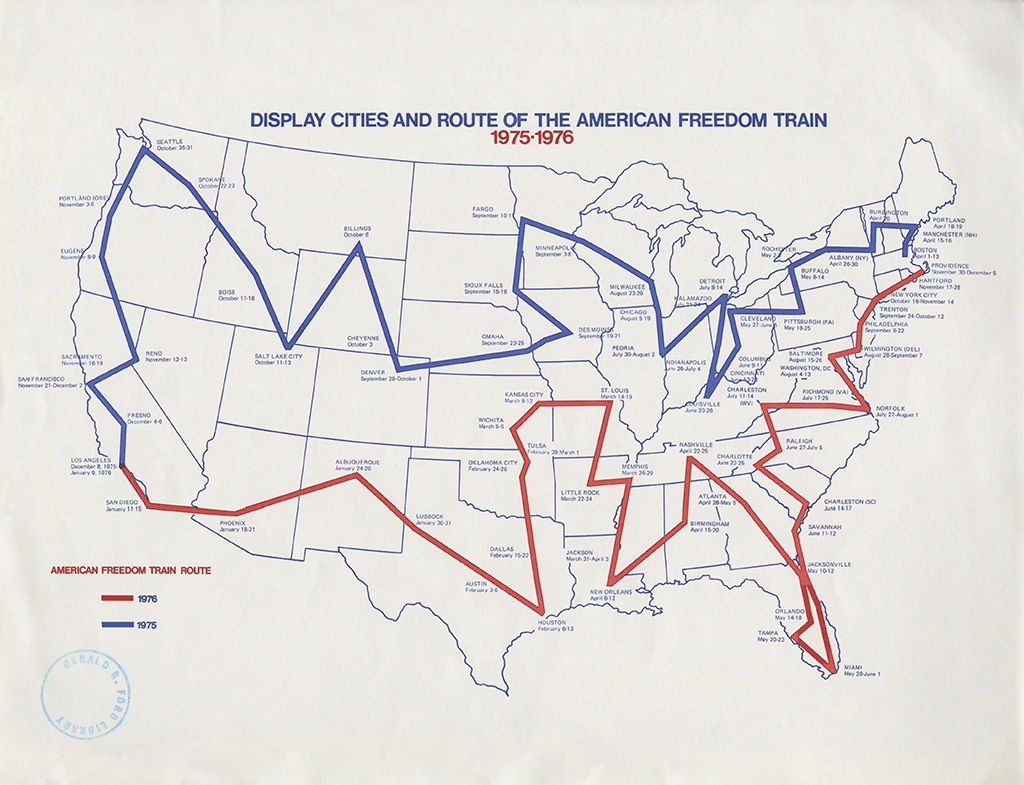
Conceived by Ross Rowland, a New York commodities broker and train preservationist, the American Freedom Train was a 26-car bicentennial museum on rails that traveled upwards of 17,000 miles across the country from April 1975 to December 1976. Advertised as a “Moving Monument to American History,” the Freedom Train made stops in 142 cities and in each of the 48 contiguous states (including Portland, Maine on April 17, 1975). More than 7,000,000 people toured the train in cities across the country, while millions more witnessed it traversing the nation. The train itself was pulled by a steam locomotive (three were refurbished for the project), “a symbol of the national soul,” according to Rowland, and a means of harkening back to the way that locomotives linked the nation together in the 1800s. Recognized as an official Bicentennial project by the American Revolution Bicentennial Administration, it was funded via corporate sponsorships from General Motors, Kraft Foods, Pepsi-Co, and the Prudential Insurance Company. Tickets cost $1 for children, and $2 for adults. The promotional film shown here covers the history of the American Freedom Train, its conception, a summation of the collection of artifacts from over 215 public and private lenders, its restoration, and an overview of its contents and journey across the country. The documentary-style film was produced by the Freedom Train Foundation and was made available to local media in advance of the train’s arrival.
After waiting in line, sometimes for an entire day, ticketed visitors were taken through the display cars on a moving sidewalk. According to a 1975 promotional brochure, “at each stop, pages of history come alive through 10 specially designed exhibit cars. Special effects immerse the train’s visitor into a total experience of sights, sounds and smells … that are America.” The narrative of the United States presented in the ten display cars was largely in keeping with other items found in the Bicentennial section of this exhibition. After starting with the Revolutionary era, the cars presented visitors with displays about American expansion, growth, immigration, innovation, work, and cultural life. The overall narrative was one of unity and progress, presenting a single story that stressed the link among past, present and future–a country continuing to realize its promise. While the final display car dealt with tensions of the American past, the last panel of the exhibit connected visitors to the larger civic project of the bicentennial by promoting a positive view of the past, a rededication to the country’s founding ideals, and a personal commitment to do the work.
It read:
Now…
LET US CELEBRATE AMERICA:
Its heritage and its strength…
and together build a meaningful tomorrow.
Freedom Train visits Portland
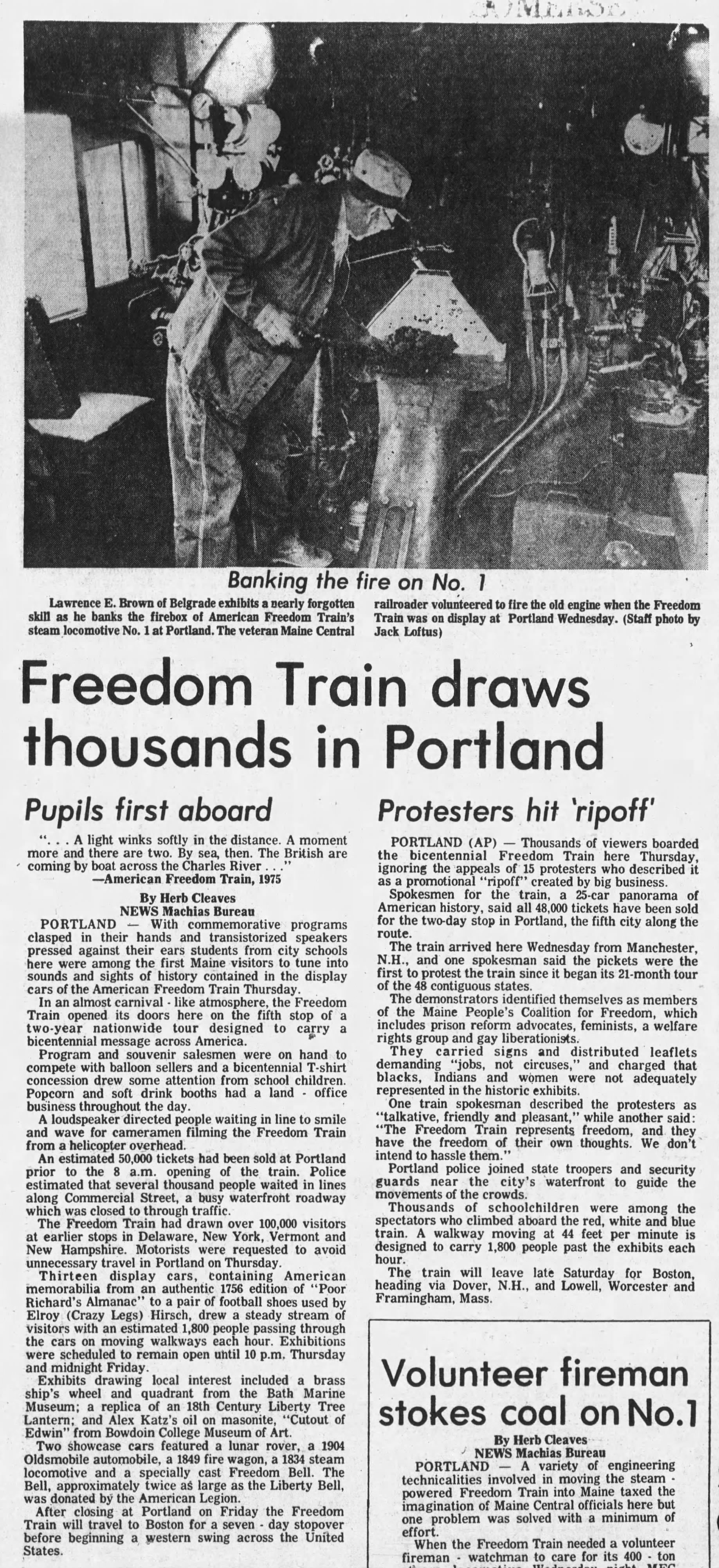
Early on its nationwide tour, the Freedom Train stopped in Portland, Maine in April 1975. This stop was marked both by being the first stop where all of the tickets sold out, and also being the first where protesters picketed the train. Official celebrations such as the Freedom Train framed the Revolution as a triumphant national story of American progress. Yet activists, artists, and scholars used the bicentennial moment to highlight the gap between Revolutionary ideals and the reality of living in America in the 1970s. As Susgan Henderson, a gay rights activist involved in the protests, reflected in an editorial in Mainely Gay, “We picketed the Freedom Train because it was commercial and left out minority groups, including ours.”