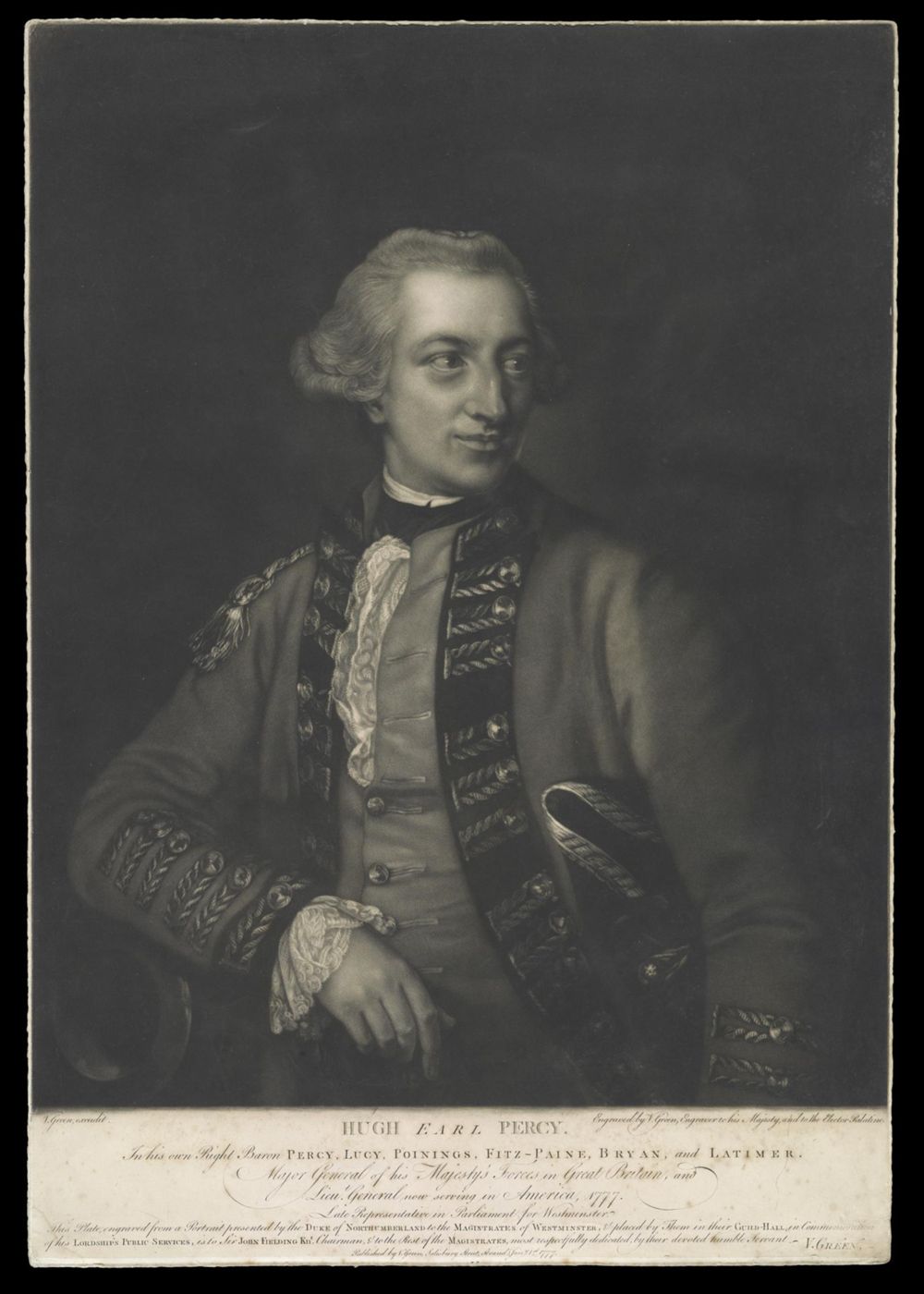
Colonel Hugh Earl Percy, son of the Duke of Northumberland was a career Army Officer in the British Army and member of Parliament for Westminster. He voted against the Stamp Act in 1765 and for its repeal in 1766, sympathizing with the colonists in their complaints against the Crown. Nonetheless, he joined his regiment, the 5th Foot, when it was posted to Boston in 1774, and soon became a general officer in charge of the Boston Garrison. Before leaving Europe, Percy bought a set of detailed geographical maps of the colonies, including this map of New England. In Boston, Percy collected information about regional roads, which he added to this map in pencil and ink, as a way to organize strategic knowledge of the region as a potential arena of conflict.
Despite Percy’s annotations, his map of New England was too coarse to be useful for tactical information. For example, Percy’s annotations recorded the existence of roads—such as those from Cambridge to Lexington and Concord—but without the precision needed to actually travel them. When, on April 19, 1775, Percy led the relief column to rescue the regiments sent out to destroy the colonials’ stockpiles of guns and powder at Lexington and Concord, he still had to ask in Cambridge about which road leaving the common went to Lexington, and he relied on his scouts to find a route to escort the beleaguered advance column across country to Charlestown and the protection of naval guns. Green’s map was never intended for tactical purposes. If they survive, tactical maps used in battle are found today in official and family archives. Percy’s map does, however, demonstrate that the British did indeed have some knowledge of the countryside prior to the battles of Lexington and Concord.
Percy’s political sentiments meant that he was not fully trusted by his superior officers. After being sidelined to command a garrison in Rhode Island, he returned to Britain in 1777, taking his maps with him. Percy lodged the maps in his family library at Sion House in London (note: it was Percy’s librarian who cut the map up and glued it to cloth so that it could be folded up for safekeeping). Dr. Harold Osher acquired Percy’s map in 1998, following the auction of the Sion House library in 1997.