Hiding behind this seemingly stable technological narrative lay a large number of artists and craftsmen who were inveterate tinkerers, all seeking new techniques to overcome persistent problems or to develop new ways of creating and printing images. Cost was always an issue. In Britain, for example, when it began the detailed mapping of extensive areas at very large scales, the Ordnance Survey had to figure out how to print hundreds of sheets in relatively small numbers without breaking the bank. The survey’s superintendent, Col. Henry James, gave up on copper engraving and developed a photographic method to transfer the surveyors’ neat, hand-drawn plans directly to zinc plates for printing. Yet, as with other photographic techniques for transferring images, “photozincography” worked well with lines, which comprised the detailed survey sheets, but it could not manage the reproduction of tones and textures.1
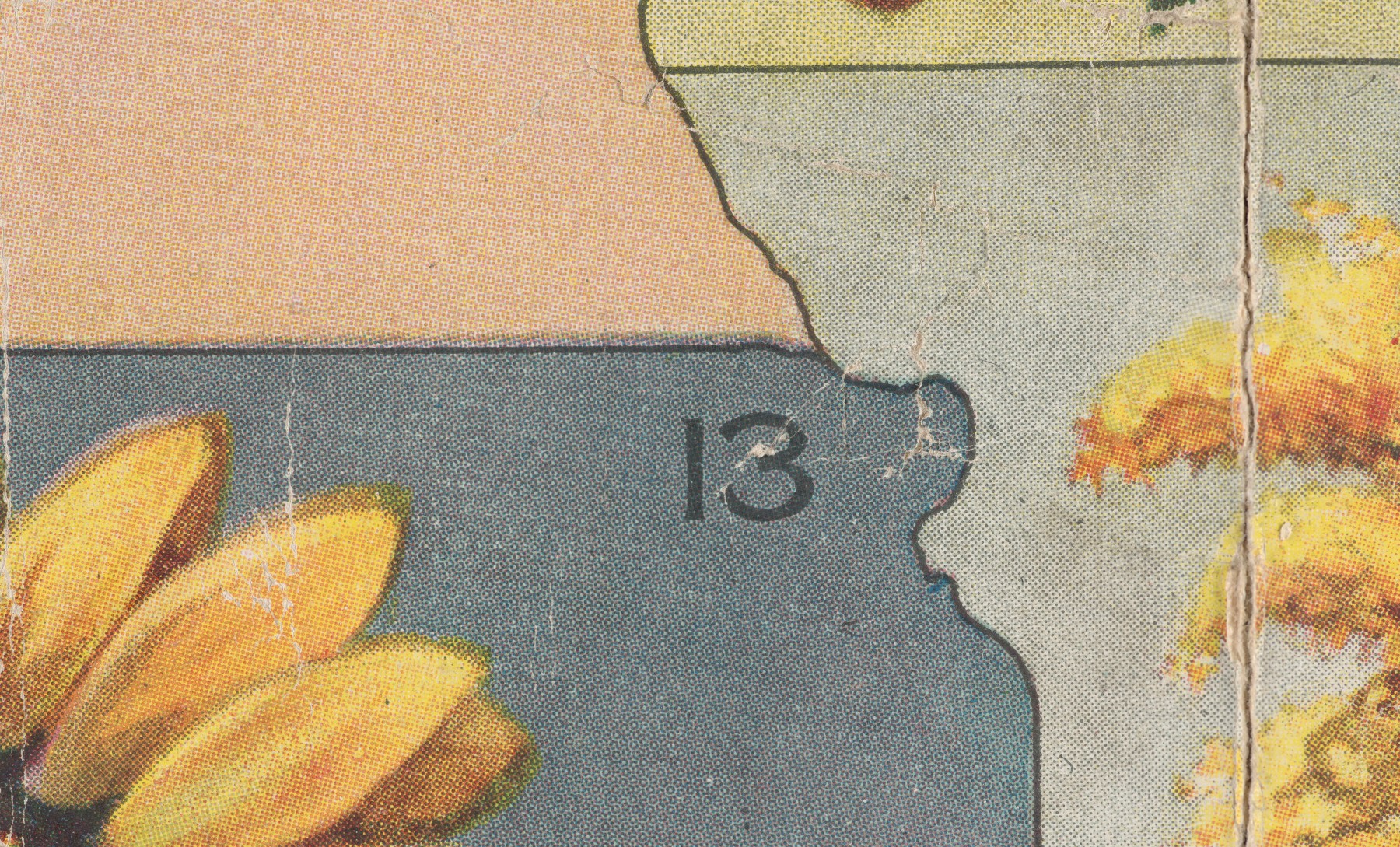
Many printers worked to overcome this problem, eventually producing the first successful “halftone screens” in the 1880s. A halftone screen is basically a fine array of opaque dots on a transparent (glass) substrate; by projecting a photographic negative onto a print through such a screen, a print is formed from dots of subtly different sizes that capture the tonal variations of the original work, although all the dots are themselves constant in tone.2 Screens might also be used in transferring images to lithographic printing surfaces. In this practice, the texture of ink from a hand-prepared planar printing surface is replaced by a uniform sea of fine dots that, at a regular viewing distance, blur together into a constant tone. The printing surfaces that produced Our National Bouquet in 1911 [Cat. 92] were prepared in this manner (fig. 45).
After 1900, halftone screens were combined with older ideas of color separations to create a quite new approach to printing color.3 The physicist James Clerk Maxwell had in 1861 demonstrated the separation of color images into red, green, and blue components (RGB). In the late 1860s, in France, Louis Ducos du Hauron distinguished between the additive and subtractive primary colors. RGB were the additive primaries: superimposing them together makes white; this is the principle behind digital monitors that emit different amounts of red, green, and blue to make multiple hues and values from black to white. Conversely, the subtractive primaries represent reflected light: when light, from the sun or from a lamp, strikes a surface, some wavelengths are absorbed and others reflected; the reflected light gives the surface its apparent color; when all the wavelengths are absorbed, and no light is reflected, the surface appears black, when all are reflected, it looks white. The subtractive primaries of cyan, magenta, and yellow (CMY) model this process by defining the colors to be reflected: superimposing them together makes a black surface. It is therefore possible to produce any colors in a printed image by using different combinations of CMY.
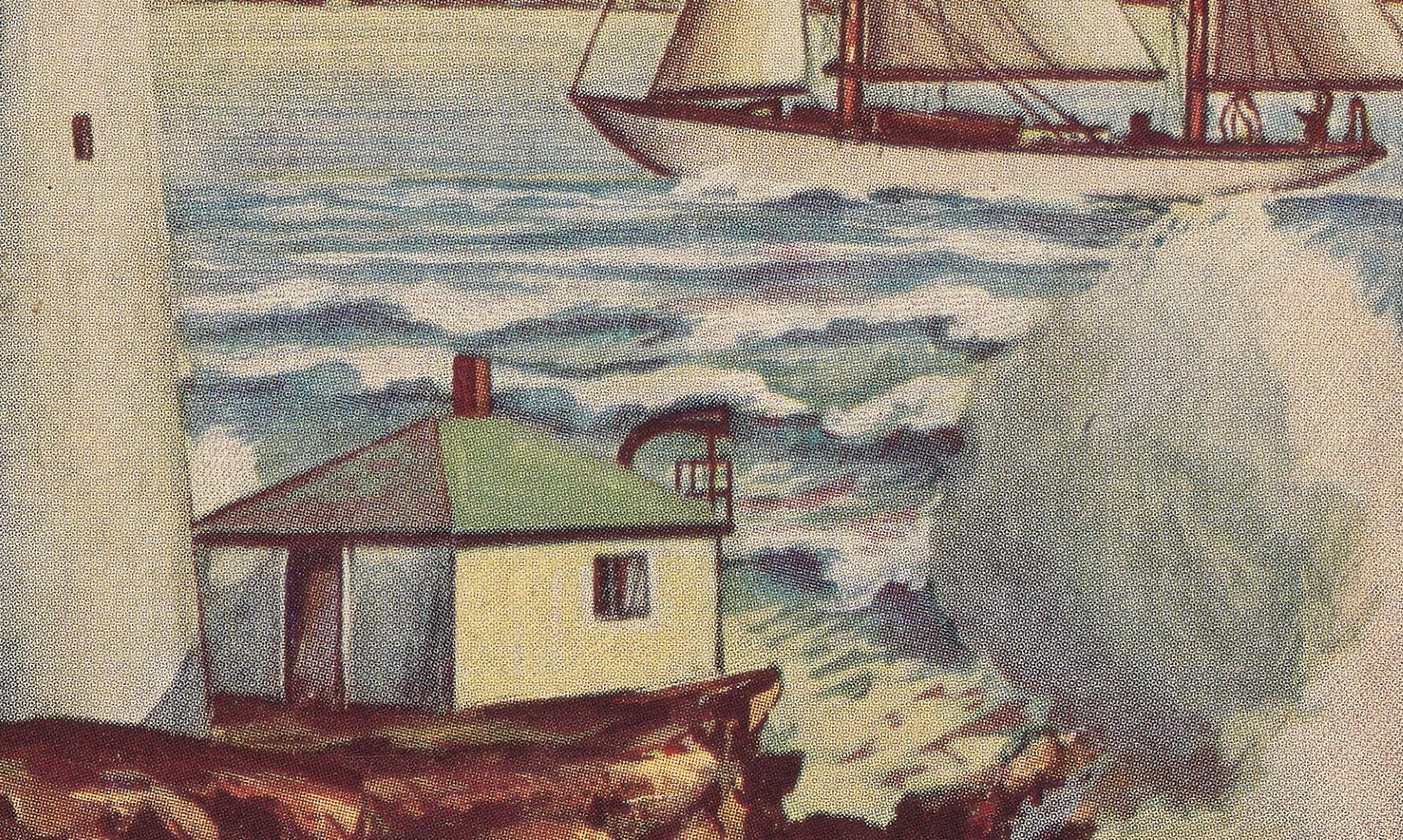
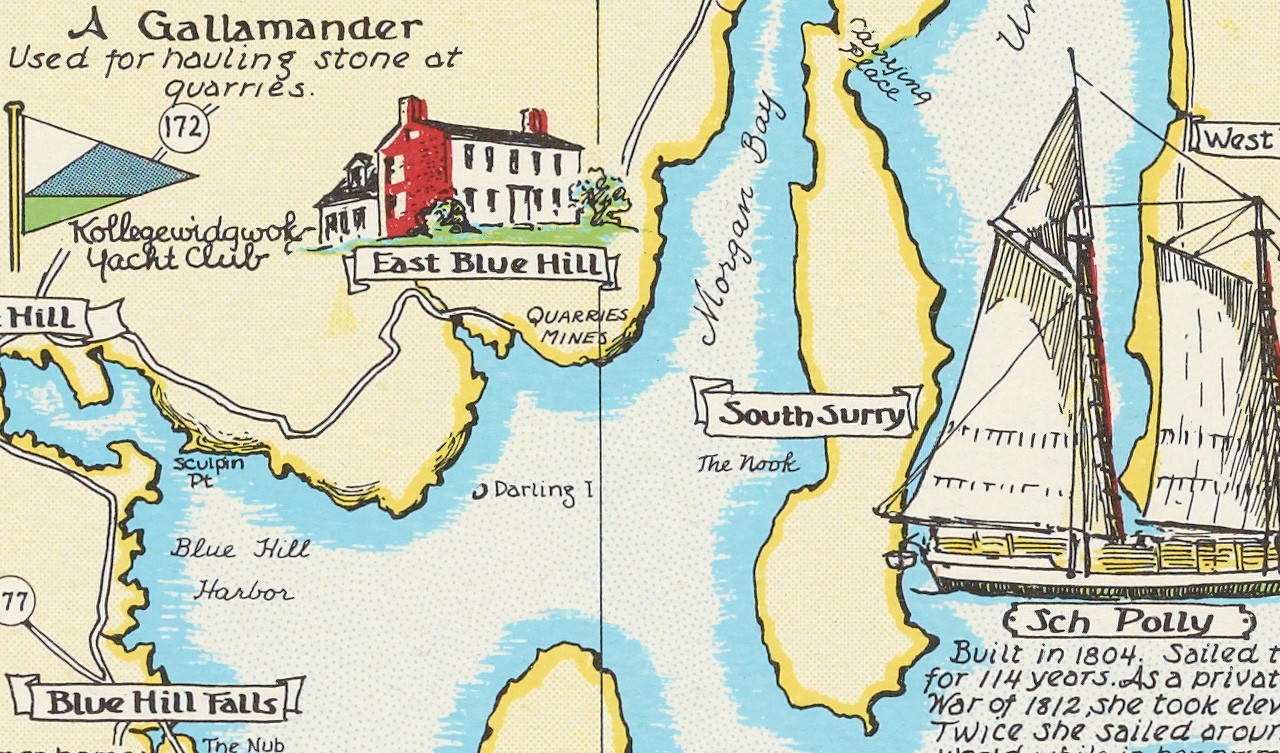
But how to do so? The answer is to use screens of different densities to build up each of the cyan, magenta, and yellow printing surfaces. No screen for the lines that make up the edges of a river, to be printing in 100% cyan, but perhaps a 40% screen for the cyan to fill the river, and so on. Because maps and other images generally have a lot of black in them, the three subtractive primaries are often complemented by a fourth color, black (to make CMYK). Four-color printing took off after 1900.4 To be sure, the new technologies passed through a transitional period, in which inks in the subtractive primary colors were used with other inks (fig. 46), before strictly four-color printing became standard (fig. 47).
The huge benefit of four-color CMYK printing is that ink manufacturers can focus on making large quantities of just four colors of ink, significantly reducing the cost. CMYK are today known as “process” colors, whereas all the inks created to have a specific color of their own (this shade of red, that yellow with a hint of orange) are called “spot” colors. Spot colors are used only when precise color control is important and large print runs justify the extra cost of specialized inks.
Four-color printing effectively sounded the death knell for chromolithography. By the end of World War I, commercial printers had essentially abandoned the technique. The combination of the subtractive primaries with halftone screens allowed very precise control over and registration of printed color. A whole new suite of materials and techniques were developed to combine hand-drawing with photographic films in what is generally called “photomechanical” printing. Photomechanical techniques rapidly gave way after 1990 to new digital technologies, especially the color laser printer for producing relatively small numbers of prints. Designers can now select a menu item to convert their digitally prepared images into four-color separations that can be turned directly into photographic negatives for the preparation of offset lithographic printing surfaces for much larger print runs.
Chromolithography, which once created its own revolution in the printing of color images, is now two revolutions old. Displaced by color photography, its lush and complex images (even if sometimes overly sentimental) have become hallmarks of how late-Victorian society viewed the world around them. From bird’s-eye views to small trade cards, chromolithography worked in conjunction with monochrome photography to create a new obsession with seeing the world “as it is,” even when the view is from an impossible or artificial vantage point.
Notes
-
Mumford, “Lithography, Photography and Photozincography.” See also Damien Bove and Catherine Delano Smith, “Can You Trust a Facsimile? The Ordnance Survey and the Gough Map,” Sheetlines 119 (2020): 49–55. ↩︎
-
Gary G. Field, The Color Printing Revolution: Productivity! Creativity! Quality! (San Louis Obispo: California Polytechnic State University, Graphic Communication Institute, 2015), 47–48. ↩︎
-
Field, Color Printing Revolution, 29–30. ↩︎
-
W. Gamble, “Modern Colour Processes,” in Burch, Colour Printing and Colour Printers, 253–74. ↩︎